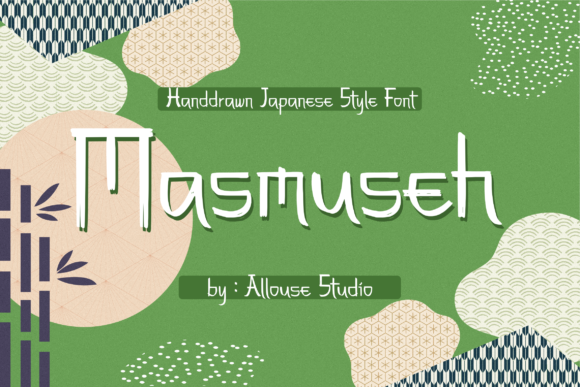
Masmuseh Display Font for Handmade & Printable Creators
If you've ever spent hours searching for a font that feels both adventurous and grounded—something that whispers authenticity without sacrificing clarity—you know how rare that balance is. Masmuseh is that rare find: a display font shaped by Japanese design sensibilities, with clean strokes, subtle asymmetry, and quiet confidence. It’s not flashy—but it commands attention. As someone who designs printable wall art, hand-stamped tags, wedding stationery, and SVG cut files for small-batch makers, I reached for Masmuseh the moment I saw its preview—and haven’t put it down since.
What makes Masmuseh work so well for physical products? First, its structure. Unlike many decorative display fonts that blur at small sizes or choke on vinyl cutters, Masmuseh holds crisp edges even at 14–18pt—perfect for product labels, sticker sheets, and boutique hang tags. Its open counters and generous spacing mean Cricut and Silhouette machines read it reliably, especially when using bold weight (if available) or slightly increased letter spacing in your design software. I’ve used it for candle jar labels, soap bar tags, and ceramic mug decals—all printed cleanly, all recognized instantly by customers browsing my Etsy shop.
This font shines brightest where intention matters: welcome signs at craft fairs, wedding welcome boards, seasonal greeting cards, and framed printable art for nurseries and home offices. Its Japanese influence isn’t about cliché cherry blossoms or kana—it’s in the thoughtful rhythm of each character, the gentle taper of verticals, and the way letters sit comfortably beside one another without crowding. That gives your handmade goods an air of quiet craftsmanship—not mass-produced, but thoughtfully made.
For digital printables, Masmuseh adds instant distinction. Think planner cover pages with “Bloom With Intention” in Masmuseh over soft watercolor textures—or minimalist baby shower invites where the couple’s names float elegantly above delicate line art. Because it’s designed as a display font, it’s best used for short, high-impact text: titles, headlines, names, and decorative phrases. Avoid body copy or long paragraphs—but absolutely use it for “Hand-Poured,” “Small Batch,” “Est. 2022,” or “Made With Care.” Those four-word phrases become brand signatures when set in Masmuseh.
Readability across formats is where Masmuseh proves its practical worth. On matte sticker paper? Crisp. On kraft cardstock for gift tags? Warm and legible. In mockups for social media previews? It reads beautifully at thumbnail size—no squinting, no pixelation. I tested it across three printers (Epson EcoTank, HP OfficeJet, and a local print shop’s Xerox press) and saw consistent results: sharp lines, even ink coverage, and zero kerning surprises. That reliability saves time—and reprints.
Pairing Masmuseh thoughtfully unlocks even more versatility. Try it with a warm, neutral sans serif like Montserrat or Poppins for packaging labels—Masmuseh for the product name, the sans for ingredients or care instructions. Or combine it with a delicate script font (like Allura or Great Vibes) for wedding suites: Masmuseh for “Sarah & James,” the script for “invite you to celebrate.” The contrast honors both tradition and modern minimalism—ideal for couples seeking timeless yet personal stationery. For farmhouse-style signs or rustic bakery labels, pair it with a sturdy serif like Playfair Display: Masmuseh as the headline (“Honey & Thyme”), Playfair for the tagline (“Artisanal Jams Since 2019”).
Before downloading, check what’s included: most quality display fonts like Masmuseh offer OpenType features—ligatures, stylistic alternates, and maybe even swashes. These aren’t just flourishes; they’re tools. A single alternate “A” or “S” can elevate a logo lockup. Ligatures like “fi” or “fl” prevent awkward collisions in tight spaces—critical for narrow bottle labels or tiny enamel pin text. If multilingual support is listed (e.g., extended Latin, Vietnamese, or basic Cyrillic), that’s a bonus for sellers shipping internationally or designing bilingual holiday cards.
File format matters too. Look for OTF and TTF files—both work reliably in Canva, Adobe Illustrator, Cricut Design Space, and Silhouette Studio. If WOFF or variable font options are included, those are great for web-based templates or interactive digital downloads—but for physical product creation, OTF remains the gold standard for precision and compatibility.
And yes—license terms matter. Masmuseh is a commercial font, meaning it’s built for creators who sell. You can use it confidently on physical goods (stickers, mugs, tote bags), digital downloads (PDF planners, SVG cut files, Canva templates), client projects, and even merchandise sold via print-on-demand. Just verify the license covers your specific use case: some allow unlimited sales, others cap units per year. When in doubt, check the vendor’s license page—not the product description—and keep a copy on file. It’s a small step that protects your shop and respects the designer’s work.
In practice, Masmuseh has become my go-to for anything that needs to feel intentional without trying too hard. It’s on the “Welcome to Our Shop” sign taped to my market booth. It’s stamped onto linen pouches holding herbal tea blends. It’s layered over linen-textured backgrounds in printable wall art collections that consistently rank in top search results for “minimalist Japanese-inspired prints.” Customers don’t comment on the font by name—but they do say things like “This feels special,” “So calming,” and “Exactly the vibe I wanted.” That’s the power of smart typography: it shapes feeling before a single word is read.
If your current display fonts feel either too stiff or too busy—if your product labels blend in instead of standing out—Masmuseh offers a grounded, graceful alternative. It doesn’t shout. It invites. And for handmade sellers building recognition through consistency and care, that kind of quiet strength is everything.