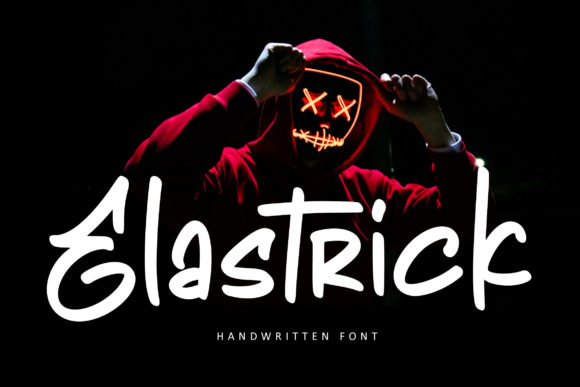
Elastrick: A Cool Urban Display Font for Handmade Creators
If you've ever spent hours searching for a font that feels effortlessly cool—casual but intentional, urban but warm, stylish but still cuttable—you’ll instantly recognize Elastrick. It’s not just another script font. It’s a display typeface with rhythm, attitude, and real-world craft utility. As someone who designs printable wall art, cuts vinyl for boutique tags, and builds digital templates for fellow Etsy sellers, I’ve tested dozens of “handwritten” fonts—and Elastrick stands out because it balances expressive flair with clean legibility across physical and digital formats.
Elastrick lives in the Script Amp category, which means it’s built for impact—not body text. Its letterforms have subtle bounce, relaxed spacing, and a confident slant that reads as modern without trying too hard. Think of it as your go-to font for when you want energy, authenticity, and approachability all at once. It’s the kind of typeface that makes a candle label feel curated, a wedding welcome sign feel personal, and a t-shirt slogan feel like it belongs on a streetwear drop.
Where Elastrick Shines in Real Craft Projects
This isn’t a font you’ll use for ingredient lists or fine print—but it’s perfect where attention, emotion, and brand voice matter most. Here’s how I use it across my own product lines:
- Product labels & tags: Elastrick works beautifully on kraft paper stickers, hang tags for handmade soaps, and woven fabric labels for apparel. Its open letterforms hold up well at 10–14 pt sizes, and the casual weight avoids looking cramped or fussy.
- Greeting cards & invitations: Whether it’s a birthday card with “Happy Birthday!” in bold caps or a minimalist baby shower invite with “Welcome Little One,” Elastrick adds warmth without sacrificing polish. It’s especially effective for names and short phrases—never overused, always memorable.
- Wall art & signs: From farmhouse-style wooden signs to printable planner headers, Elastrick scales cleanly. I’ve used it at 36 pt for laser-cut acrylic pieces and at 180 pt for large-format canvas prints—both times, the curves stayed crisp, and the rhythm kept the eye moving naturally.
- Digital printables & templates: In Canva, Silhouette Studio, and Cricut Design Space, Elastrick imports smoothly as OTF or TTF. I pair it with editable text boxes in my SVG bundles so buyers can personalize names and dates—no font substitution needed.
- Seasonal & boutique packaging: Holiday mugs, summer tote bags, back-to-school stickers—Elastrick adapts. Its urban edge gives seasonal designs a contemporary lift, while its readability ensures “Merry & Bright” or “Sunshine & Saltwater” stays clear even on curved surfaces or textured fabrics.
Readability Matters—Especially When You’re Cutting or Printing
Let’s be practical: if your font doesn’t cut cleanly on a Cricut or Silhouette, or if it blurs when printed small on a sticker sheet, it’s not saving you time—it’s costing you reprints and customer messages. Elastrick was clearly designed with production in mind. The terminals are open (no tight loops), the x-height is generous, and the contrast between thick and thin strokes is moderate—not extreme like some decorative scripts. That means:
- No dropped letters when cutting vinyl at 1/8" height
- No pixelation in black-and-white PDF printables at 300 dpi
- No awkward kerning surprises when typing names into mockups
- No need to manually adjust spacing for most common phrases
I recommend using Elastrick at minimum 16 pt for printed greeting cards and 24 pt for product tags meant to be read from 2–3 feet away. For wall art or signage, go bolder—the font includes a full uppercase set with optional alternates and ligatures, so “THE COFFEE BAR” or “SUNSET VIBES” can have extra personality without losing cohesion.
Smart Pairings That Elevate Your Brand Identity
Elastrick thrives when paired intentionally. Because it’s a display font—not a workhorse—I almost always combine it with something grounded. My top pairings:
- Elastrick + a clean sans serif (like Montserrat or Inter): Perfect for logos, shop banners, and packaging where Elastrick handles the brand name and the sans serif handles descriptors (“Hand-poured Soy Candles” or “Est. 2021”).
- Elastrick + a gentle serif (like Playfair Display or Cormorant Garamond): Ideal for wedding stationery—Elastrick for “Emma & James” and the serif for date, location, and RSVP details.
- Elastrick alone, in all caps, with tight tracking: A surprisingly strong look for social media graphics, digital stickers, or minimalist tote bag designs.
Licensing, Formats, and What You Need to Know
Elastrick comes as a standard desktop font package (OTF/TTF), fully compatible with Adobe Creative Cloud, Affinity apps, Cricut Design Space, Silhouette Studio, and free tools like Canva and Google Fonts alternatives. It supports multilingual Latin-based languages—including accented characters for French, Spanish, and German—so if you sell internationally or design bilingual invites, you’re covered.
Crucially, Elastrick includes a commercial license. That means you can use it to create and sell physical products (t-shirts, mugs, stickers), digital downloads (printables, SVG files, Canva templates), client work (logo design, packaging), and even subscription-based design assets—no extra fees or attribution required. Just keep your license file handy for records, and avoid embedding the font in apps or web fonts unless explicitly permitted.
As a maker who’s learned the hard way about font licensing pitfalls, I appreciate that Elastrick is straightforward: no confusing tiers, no “personal use only” traps, and no surprise restrictions when scaling your shop. It’s a premium font built for real business—not just pretty previews.
Whether you're hand-lettering digitally, prepping files for DTG printing, or building your first Etsy printable bundle, Elastrick brings consistent charm, reliable performance, and quiet confidence to every project. It doesn’t shout—it leans in, smiles, and makes your work look like it belongs somewhere special.